Why printed wristbands have become essential in modern event management
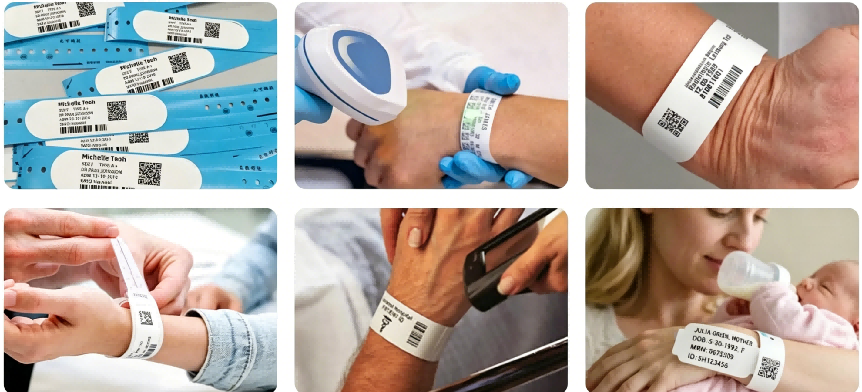
In the world of event organization – festivals, conferences, amusement parks – managing crowds and access remains a permanent challenge. Long dominated by easily forged paper tickets and plastic wristbands without any information, this management approach has shown its limits.
These pain points center on three major areas:
- Ticketing and verification: paper tickets get lost, torn, and counterfeited. At the entrance, manual scanning is slow, creating endless queues that harm the participant experience.
- Crowd control and security: without a reliable identification system, it is nearly impossible to distinguish a simple spectator from a VIP, an exhibitor from a technical staff member. This confusion increases the risks of intrusion and overcrowding.
- The participant experience: no one appreciates waiting in line for an hour or being denied access to a paid area because of an illegible wristband.
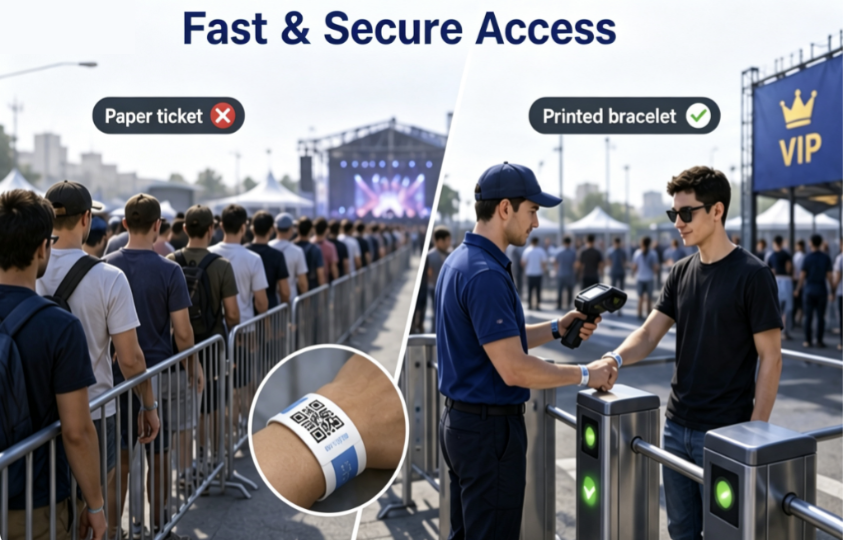
Faced with these observations, the printed wristband stands out as an obvious solution. It transforms a simple physical link into a true digital tool, integrating QR codes, RFID chips, and visible data. A wristband printer that is well chosen becomes a strategic lever. One central question remains: how can these wristbands be produced on demand, reliably, and adapted to each context?
What is a wristband printer and what types of wristbands can it print?
A wristband printer is specialized equipment designed to produce identification wristbands on demand, often integrated with access control systems. It differs from conventional printers in its ability to handle a variety of media and withstand harsh environments.
Three main technologies are used:
- Direct Thermal: simple and economical, the thermal wristband printer prints on thermal paper without a ribbon. Ideal for short events (under 24 hours), but prints can fade in heat.
- Thermal Transfer: the thermal transfer wristband printer uses a ribbon to transfer ink onto the wristband. It offers superior resistance to water, friction, and UV, perfect for multi-day events.
- RFID: although it is an embedded chip, some RFID wristband printers allow simultaneous encoding, linking the wristband to a database for real-time tracking.
The choice of technology determines the compatible materials. As for wristband types, we distinguish:
- Medical wristbands: often in Tyvek or vinyl, they require resistance to alcohol and heat for hospital use.
- Event/leisure wristbands: in Tyvek, PVC, or fabric, they are designed for festivals and amusement parks.
- Smart RFID wristbands: they integrate a chip enabling contactless payment or geolocation.
Thus, understanding the technologies and wristband types is an essential first step. It is still necessary to know in which contexts these solutions are actually deployed.
What types of events or sectors use printed wristbands?
The use of printed wristbands extends far beyond simple access. Here are the main sectors and their specific requirements.
1. Event and entertainment sector:
This sector makes extensive use of an event wristband printer capable of adapting to various constraints.
- Music festivals and concerts: the printer produces Tyvek wristbands on the fly to serve as access tickets. Color distinguishes standard attendees from VIPs or artists. Tyvek is ideal because it is ultra-lightweight, waterproof, and tear-resistant for a day-long event.
- Water parks and amusement parks: the requirement here is total waterproofing. PVC or synthetic wristbands are used, resistant to chlorine and friction. Many integrate an RFID chip, and this is where an RFID wristband printer becomes indispensable for encoding and personalizing each wristband with payment and access data.
- Sporting events (marathons, triathlons): fabric wristbands resist sweat and impact. They are used for runner identification, timing, and access to secure areas.
- Resorts and cruise ships: the wristband replaces the room card. Made of fabric or soft PVC, it is worn for several days and is used for door opening, onboard payments, and activity reservations.
2. Corporate and security sector:
- Conferences and trade shows: the Tyvek or durable paper wristband advantageously replaces the cardboard badge. It allows fast scanning at entry and effective control of access to different sessions.
- Corporate and government events: wristbands with a unique QR code or RFID chip are used to manage internal visitors and control access to specific areas (backstage, offices). An RFID wristband printer is also valued here for its encoding speed and reliability.
3. Medical sector:
Hospitals print soft vinyl wristbands upon admission, resistant to alcohol and disinfectant products. A medical wristband printer stands out for its ability to handle specific media and produce prints that are ultra-resistant to friction and liquids. It guarantees infallible patient identification, from admission to discharge.
What are the advantages of using printed wristbands in event management?
Adopting a wristband printing solution offers measurable benefits that transform event logistics:
1.Reduction of fraud and securing of access
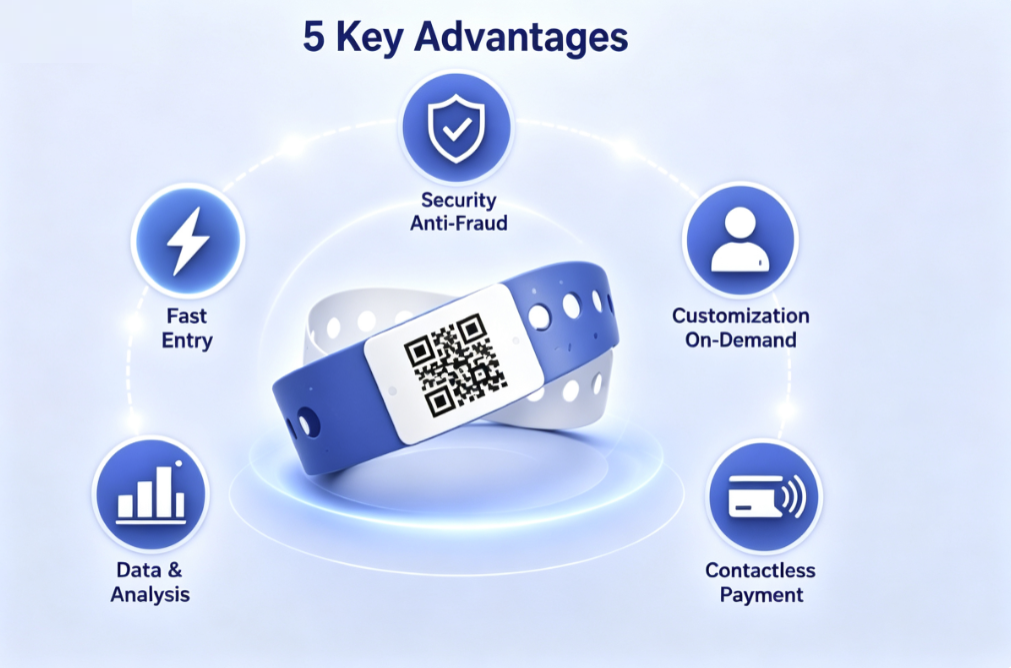
Printed wristbands with unique QR codes or RFID chips are extremely difficult to reproduce or transfer. Each entry is tracked, eliminating losses linked to counterfeiting.
2. Acceleration of entry flow
With optical scanning or RFID reading, validation time drops from several seconds (paper ticket) to less than one second per participant. This considerably reduces queues.
3. On-demand personalization
You can print specific information (name, ticket number, access category) in real time, directly at the entrance, without any stock of pre-printed wristbands.
4. Improvement of the participant experience
Smooth access reduces stress. Moreover, wristbands can serve as a means of payment or a networking tool (e.g., exchanging contact details by scan), making the event more interactive.
5. Traceability and analytics
Connected wristbands allow organizers to know in real time how many people are on site, their location, or the busiest areas.
These five advantages show that printed wristbands are no longer simply an accessory, but a strategic tool. The equipment used must still be up to these requirements. Not all printers allow reaching this level of security, speed, or traceability.
How to choose your wristband printer for events properly?
Choosing a wristband printer is not just about comparing prices. Here are the essential technical criteria to evaluate before any purchase.
① Volume and speed
A consumer-grade printer prints at 50 mm/s, a professional model at 150 mm/s. For 10,000 wristbands per day, the time saved is considerable. At 150 mm/s, the continuous printing of a 150 mm wristband takes only one second, compared to three seconds at 50 mm/s. Speed is a key factor in avoiding queues.
② Resistance and environment
For a three-day outdoor festival, thermal transfer with a resin ribbon is indispensable. This process withstands temperatures up to 70°C and prolonged UV exposure, without which barcodes become illegible as early as the second day.
③ Connectivity and software
USB and Ethernet are essential. For outdoor use, prioritize Wi-Fi or Bluetooth. A buffer memory of 100 to 200 wristbands allows printing even in the event of a network failure, avoiding any interruption at the entrance.
④ Media compatibility
The standard width is 25.4 mm, but some models accept up to 54 mm for premium fabric wristbands. A black mark sensor is essential for continuous rolls, with detection accuracy of less than 2 mm.
⑤ TCO and durability
A professional model achieves 300,000 cycles MTBF compared to 50,000 for a consumer model. At a rate of 30,000 prints per event, the risk of failure on a consumer model exceeds 60%. The higher initial investment is quickly recouped by avoiding a ticketing interruption in the middle of service.
Conclusion
Modern event management can no longer afford the security flaws, endless queues, and limited personalization options of traditional methods. The on-demand printed wristband has become a standard, combining speed of control, unforgeable traceability, and a smooth participant experience.
To achieve this level of requirement, the choice of your wristband printer rests on three pillars: print volume (and therefore speed), the usage environment (direct thermal or thermal transfer), and compatibility with your media (Tyvek, PVC, fabric). Do not forget to integrate network connectivity and total cost of ownership into your decision. Depending on your needs, a suitable wristband printer can make the difference between a smooth entry and a bottleneck.
Whether you are organizing a music festival of 50,000 people, a professional conference, or a sporting race, there is a wristband printer specifically designed for your context. In high-traffic environments, a high-performance wristband printer guarantees not only printing speed but also the reliability of access throughout the entire event. For festivals or amusement parks, an event wristband printer associated with the right material is not limited to printing access: it contributes to security, branding, and the operational success of your event.