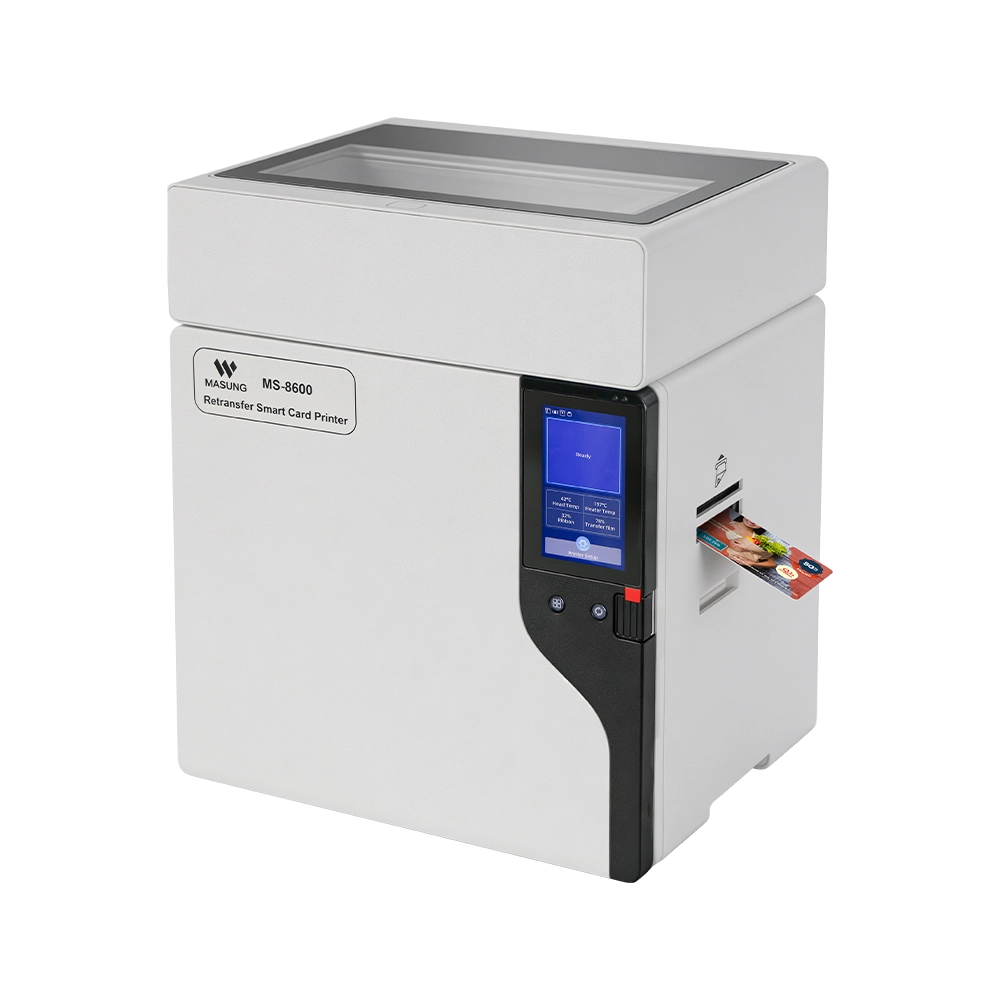
What Is a Retransfer Card Printer & How Does It Work?
A retransfer printer for ID cards — also known as a reverse transfer card printer — is a machine that prints high-definition, edge-to-edge plastic cards. Unlike direct-to-card printing, which applies dye directly onto the card surface, retransfer technology first prints the image onto an intermediate film, then uses heat and pressure to bond that film onto the card. This two-step process delivers full-bleed coverage, sharper image quality, and better durability—especially on cards with uneven surfaces like embedded chips—making it a preferred retransfer printer for smart cards.
The printing process works in two stages. First, the PVC card retransfer printer uses dye-sublimation to transfer the image—text, barcodes, and photos—onto a clear film. The print head never touches the card, reducing wear from dust and debris. In the second stage, a heated roller presses the film onto the card surface, conforming smoothly around raised chips and RFID antennas to eliminate print gaps or “ghosting” common with direct-to-card printers. The final card has a protective overlay that resists scratches, UV fading, and tampering—making this high-definition retransfer card printer suitable for IDs that must last for years in daily use.
Quick Comparison: Retransfer vs. Direct-to-Card
| Feature | Direct-to-Card (DTC) | Retransfer (Reverse Transfer) |
| Printing Principle | Print head heats ribbon, sublimating dye directly onto card. | Image printed onto film, then transferred to card via heat and pressure. |
| Printing Coverage | Leaves a white border; no full-bleed. Print head wears from card edges. | Full edge-to-edge coverage. Print head never contacts the card. |
| Image Quality | Moderate; color breaks possible on uneven surfaces. | Photo-realistic with vivid colors and smooth gradients. |
| Chip / Uneven Cards | Risk of print head damage or blind spots on non-flat cards. | Conforms seamlessly to chips and RFID antennas; flawless results. |
| Security & Durability | No protective layer; scratches and fades over time. | Built-in film protection; scratch-resistant, UV-protected, longer lifespan. |
What Cards and Industries Are Best Suited for Retransfer Printing?
Retransfer card printers are the go-to solution for organizations that require flawless printing on advanced card types—especially those with uneven surfaces. Their ability to print seamlessly over chips and antennas makes them indispensable for modern smart card applications.
Ideal Card Types:
- Contact & Contactless Smart Cards: Embedded microchips and antennas create non-uniform surfaces. A retransfer printer for smart cards applies film evenly over raised areas, eliminating “ghosting” or distortion common with DTC printers.
- High-Security Access Cards: The retransfer process creates a tamper-evident seal—peeling the film destroys the image underneath. This works well with holograms, UV printing, and microtext.
- Polycarbonate & Composite PVC / PET Cards: These materials offer superior heat resistance and durability, lasting up to 10 years. They are the preferred medium for PVC card retransfer printers in government and enterprise settings.
Key Industries:
- Government & National ID: Producing national IDs, social security cards, and driver’s licenses where forgery prevention and decades-long durability are mandatory.
- Education: Student IDs that combine library access, dormitory entry, and campus payments on a single card.
- Banking & Finance: Bankcards, credit cards, and premium VIP memberships with EMV chips and photo-quality imagery.
- Transportation: Contactless fare cards and permits that endure frequent handling.
- Corporate Security: Employee access badges combining physical entry with IT authentication—high-definition retransfer card printers ensure they resist daily wear while carrying high-resolution photos and encoding.
By matching the right card type to the right industry, organizations can fully leverage retransfer technology to enhance security, user experience, and operational efficiency.
How to Choose the Right Retransfer ID Card Printer
Selecting the optimal retransfer ID card printer requires a systematic evaluation of your operational needs, technical requirements, and supplier capabilities. Focus on these critical factors:
Print Volume & Speed
Assess your daily card output. Entry-level retransfer card printers produce around 100 cards per hour, while high-volume units can exceed 225 cards per hour. If you frequently print on-demand, pay attention to “first-card-out” speed as well.
Resolution
Always opt for 600 dpi—this resolution is the defining advantage of retransfer technology. Higher resolution ensures razor-sharp barcodes, microtext, and photorealistic portraits that are essential for security verification. A high-definition retransfer card printer makes a visible difference in final output quality.
Single vs. Dual-Sided Printing
Determine whether you need to print on both sides. Dual-sided printing is vital for IDs that carry emergency contacts, organ donor information, or additional access credentials on the reverse side.
Encoding & Security Modules
Verify that the PVC card retransfer printer supports integrated encoding for magnetic stripes, contact chips, and RFID. For government or high-security projects, ensure compatibility with hologram overlays and UV printing modules—features often found in premium reverse transfer card printers.
Total Cost of Ownership (TCO)
Look beyond the purchase price. Calculate consumable costs (ribbon and film), printhead replacement frequency, and potential savings from reduced reprints. A more expensive retransfer printer for smart cards with lower long-term costs often delivers better TCO over 3–5 years.
Supplier Evaluation
When sourcing from a ID card printer manufacturer—particularly from China—pay attention to lead time (typically 15–30 working days); MOQ flexibility (some offer 10–20 units for trial orders); OEM/ODM customization capabilities; stable driver and SDK support for system integration; and after-sales support, including warranty and spare parts availability.
Weighing these factors will help you narrow down the options and identify the model that best fits your specific requirements.
Conclusion
Retransfer ID card printers offer clear advantages for organizations that print on smart cards or require edge-to-edge coverage and longer card life. The technology’s protective film layer reduces reprints caused by wear or fading, and its ability to handle uneven chip surfaces makes it a practical choice for government, banking, education, and corporate security applications. Whether you need a reverse transfer card printer for national IDs or a PVC card retransfer printer for corporate access badges, the core benefits remain consistent: durability, image quality, and security.
That said, retransfer printers come with higher upfront costs and consumable expenses compared to direct-to-card alternatives. For basic, low-volume printing on standard PVC cards, a DTC printer may be more cost-effective. Evaluate your actual card types, print volume, and security needs before deciding. When choosing a card printer supplier for your retransfer printer for smart cards, pay attention to lead times, MOQ flexibility, driver/SDK compatibility, and after-sales support—these factors often matter as much as the hardware itself.
If you are looking for a reliable retransfer ID card printer for your business, the Masung MS-8600 is worth considering.