Why the Right Wristband Printer for Hospitals Matters
Accurate identification of every patient is paramount for hospital operations and inpatient safety. It is essential to fit a wristband to every inpatient’s wrist to avoid errors that could risk lives. Imagine the consequences of administering medication to a frail patient without a wristband to confirm their identity, transfusing blood to the wrong patient, or conducting an operation in error. Scarcely anything could be more serious.
Utilising dedicated wristband printer machines in hospitals can eliminate the likelihood of such disasters from the outset.
What Is a Wristband Printer Machine for Patient Identification?
A wristband printing machine is a professional device that prints wristbands for identification purposes. Among its wide-ranging applications, it is most commonly used for printing patient wristbands and event wristbands.
Wristband printing machines are classified into two main subcategories:
Direct Thermal Wristband Printer: This method heats a heat-sensitive (thermochromic) coating on the wristband material, causing it to darken to form text, barcodes, or graphics.
The pros: No ink, toner, or ribbons are required. It requires little maintenance.
The cons: Prints may fade over time if exposed to water, heat, light, or chemicals (making them less durable for long-term use).
Thermal Transfer Wristband Printer: This method uses heat to melt a wax or resin-based ink from a ribbon onto the wristband material.
The pros: It offers higher resolution and produces highly durable, water- and chemical-resistant prints, ideal for long-term wear.
The cons: It requires ribbon cartridges, which increases consumable costs.
What Do You See on a Wristband for Hospital Patients?
Fundamentally, a patient’s personal information, including their name, date of birth, and ward and bed number, is featured. You will also typically find a scannable barcode or QR code on the wristband for swift identity confirmation.
What Key Factors to Consider When Selecting a Hospital Wristband Printer?
Having reviewed the pros and cons of both types, and given that most hospitals opt for thermal transfer technology, we will focus on key factors for buying a thermal transfer hospital wristband maker.
Wristband Material Compatibility
Wristband printers for hospitals with thermal transfer printing technology are compatible with the following materials:
Paper wristbands, which are ultra-lightweight, low-cost, and smooth for high-resolution printing (300 DPI or above). As they are paper-based, they are perfect for short-term use—ideal for patients hospitalised for under three days.
Synthetic paper wristbands are lightweight, waterproof, and scratch-resistant. Also smooth, these wristbands are suitable for short-term use, with an achievable lifespan of around seven days.
PVC wristbands: Being soft, durable, and chemical-resistant, they are ideal for patients with medium or long-term hospital stays.
Fabric-coated wristbands or PET wristbands: These have a soft texture and are quite breathable, making them optimal for departments such as paediatrics and elderly care.
PE/PP wristbands, which offer tremendous durability, are widely used outdoors for emergency rescues and disaster response.
Print Quality and Resolution
Most wristband printers for hospitals offer 200 DPI or 300 DPI resolutions. DPI stands for Dots Per Inch, representing the number of printed dots within one linear inch. Naturally, the higher the number, the greater the clarity.
Generally, wristbands printed by a 200 DPI wristband printer are readable and scannable. However, given the option, one would prefer a 300 DPI hospital wristband maker for its superior resolution, provided it is not significantly more expensive. The scanning accuracy of barcode wristband printers in hospitals is of utmost importance.
Ease of Use for Medical Staff
Before you buy hospital wristband printers, ensure they feature simple media loading, one-button operation, require minimal training, and save time in high-pressure environments like A&E and ICU. These features support medical staff immensely during emergencies.
Compliance and Safety Standards
As hospitals work to combat viruses and bacteria, protecting everyone from infection is essential. All medical equipment must be maintained to high hygienic standards. Therefore, purchasing wristband printer machines that are easy to clean is a key consideration. A wristband printer for hospitals with a smooth, sealed surface is ideal.
Cost Considerations and Total Cost of Ownership
When considering the hospital wristband printer price, one must consider the total cost of ownership long-term. A standalone medical wristband printer is only useful until it runs out of wristbands and ribbons.
Given the frequency and cost of replenishing these consumables, it is often necessary to invest in higher-quality medical wristband printers. These are built for durability and can last for many years.
Secondly, sourcing a wristband printer manufacturer online can provide original-design ribbons and wristbands at a lower price than through regional agents or distributors, leading to significant long-term savings.
Furthermore, investing in a quality hospital wristband printer at a relatively higher price point means it is less likely to malfunction in the first few years, avoiding the hassle of seeking support and maintenance.
Tips for Choosing the Right Supplier
It is highly advisable to look for a wristband printing machine manufacturer that offers customisation options, technical support, OEM/ODM availability, and global shipping services. In short, look for a B2B hospital wristband printer manufacturer to build a trustworthy relationship.
For branded healthcare providers, the OEM/ODM service can offer customisable solutions to ensure the wristband printers align with your corporate branding.
Conclusion
It is essential to review the tips above before adding a wristband printer to your basket. Doing so helps ensure patient safety and efficient hospital operations. Opting for a durable wristband printer machine for long-term use is a sound decision, as hospitals are built to serve for generations.
If you are looking for a reliable paper wristband printing machine for patients, consider this model:
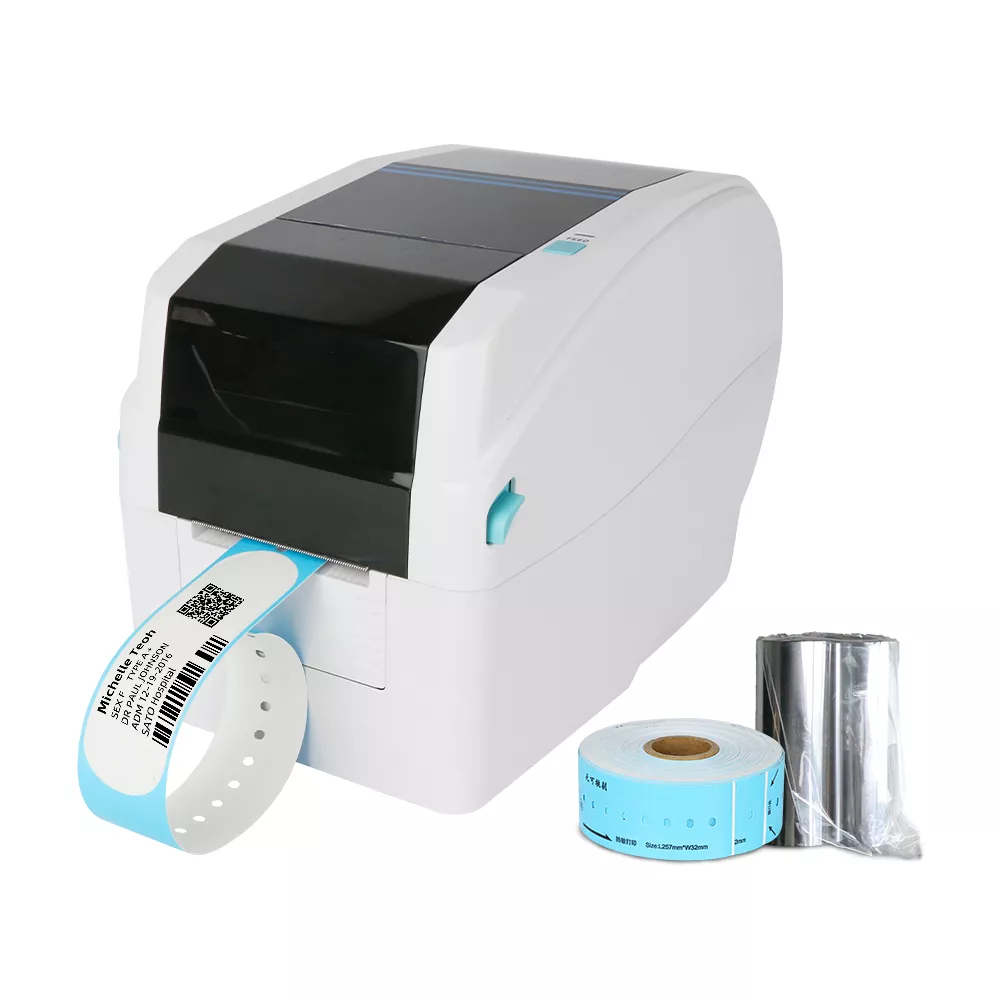
It features:
Support for both direct thermal and thermal transfer printing.
High-speed printing at 6 inches per second.
300 DPI high-resolution output.
Computer-controlled easy operation, simple maintenance, and reliable performance.
A print head and rubber rollers rated for 30 kilometers of printing.